cookie

This site uses cookies to provide you with a great user experience. By visiting monetamarkets.com, you accept our cookie policy.

Allow all
top icon

Important Information

Visitors in the United Kingdom
This website is operated by companies within the Moneta Markets group that are licensed or registered outside the United Kingdom. None of them is authorised or regulated by the UK Financial Conduct Authority (FCA).

UK residents
This website is intended for visitors outside the United Kingdom and is not intended to promote or offer services to UK residents through the overseas Moneta Markets group entities.

UK residents wishing to access Moneta Markets services should visit the dedicated UK website operated by Moneta Markets Capital Ltd, a separate FCA-authorised group company, which provides services to Professional Clients only.

By continuing to the global website, you acknowledge that it is intended for persons outside the United Kingdom and that you are accessing it in that capacity.

Moneta Markets

Please note that Moneta Markets operates this website and its services are not directed at residents of your jurisdiction.

The information on this site is not intended for distribution to, or use by, any person in any country or jurisdiction where such distribution or use would be contrary to local law or regulation.

If you have arrived here in error, we kindly advise you to exit the site.

Continue to Site
Moneta Markets
BBack Back to Blog Home

What is the Average True Range (ATR)?

December 13, 2022 | monetaeditor

What is the Average True Range (ATR)?

What is the Average True Range (ATR)?

The Average True Range (ATR) is a technical analysis indicator that measures the volatility of a financial instrument. It is typically used to identify potential entry and exit points for trades, as well as to confirm the strength of a trend. The ATR is calculated by taking the average of the true range over a given period of time. The true range is the greatest of the following three values: the current high minus the current low, the absolute value of the current high minus the previous close, and the absolute value of the current low minus the previous close.

How is it used by traders?

Traders typically use the ATR to identify potential entry and exit points for trades based on the volatility of a financial instrument. For example, if the ATR is high, it may indicate that the instrument is experiencing a high degree of volatility and is likely to continue moving in a particular direction. In this case, a trader may consider entering a trade in the direction of the trend. On the other hand, if the ATR is low, it may indicate that the instrument is experiencing low volatility and may be range-bound. In this case, a trader may choose to wait for the volatility to increase before entering a trade.

How can I add the ATR to a chart in MT4 or MT5?

To add the Average True Range (ATR) to a chart in MetaTrader 4 (MT4) or MetaTrader 5 (MT5), follow these steps:

  1. Open the chart for the currency pair, stock, or other instrument that you want to analyze.
  2. Click on the ”Insert” menu at the top of the chart and select ”Indicators” from the drop-down list.
  3. In the ”Indicators” window, scroll down until you find the ”Average True Range” and then double-click on it to add it to the chart.
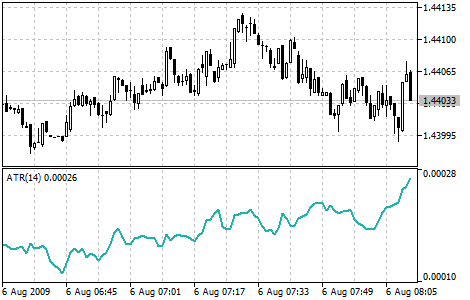
  4. The ATR will appear on the chart as a separate window below the main price chart.
  5. You can customize the appearance of the ATR by right-clicking on it and selecting ”Properties” from the context menu. This will open the ”Average True Range” properties window, where you can change the color, line style, and other settings for the indicator.
  6. Once you have customized the ATR to your liking, click ”OK” to apply the changes and close the properties window. The updated ATR will be displayed on the chart.

Average True Range - MT5 chart picture

You might also like

Arrow
Arrow
What is the Average True Range (ATR)?

Start Trading in 3 Simple Steps

1
REGISTER

Open a live account and start trading in just minutes.

2
FUND

Fund your account using a wide range of funding methods.

3
TRADE

Access 1000+ instruments across all asset classes

open chat